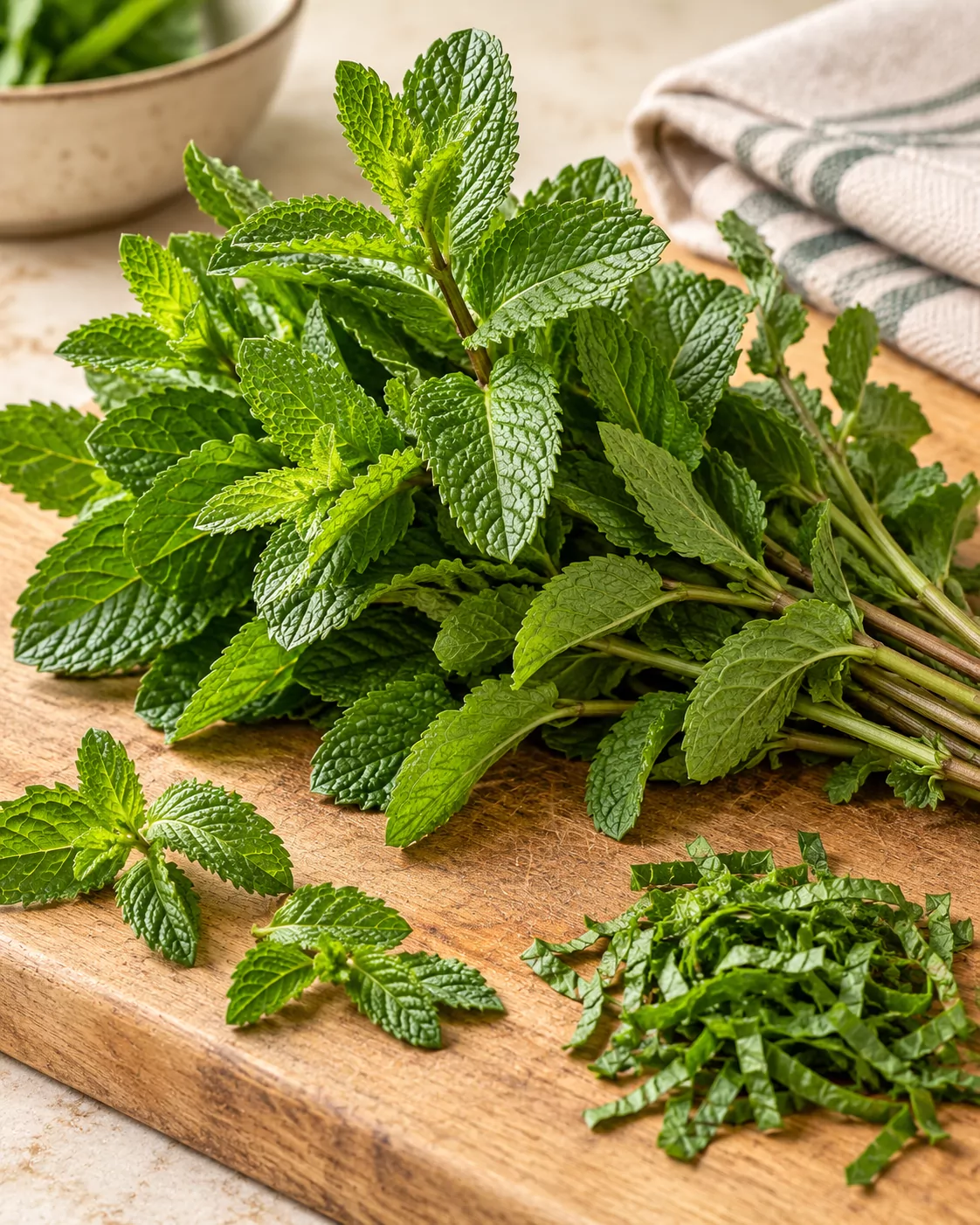
Mint
Keep the leaves dry, fragrant and proportionate so mint can cool chile, lift fruit and open up herb-led salads without taking over.
- Flavor
- Fresh, aromatic and cultivar-dependent in intensity
- Texture
- Tender leaves with usable young tips and fibrous old stems
- Best role
- A lively herb woven through fruit, grains and strongly seasoned salads
- Prime move
- Dry fully, cut late and add in layers
Five steps that protect the aroma
Sort before washing
Open the bunch, discard slimy or extensively decayed material, and separate tender upper stems from thick, fibrous lower ones. Estimate the usable quantity before assembling the salad.
Look inside: ties and dense bunches can hide damaged leaves.
Wash under running water
Rinse small loose handfuls under cool running water, turning them so both sides of the leaves are reached. Do not use soap, detergent or commercial produce wash.
For grit: work in more than one loose batch rather than packing the herb tightly into a bowl.
Dry more than seems necessary
Shake off water, spin gently if available, then spread the mint on a clean towel and pat the upper surface. Wait until no beads remain in the folds.
Protect distribution: wet mint dilutes dressing, sticks to a knife and forms dark clumps.
Choose tearing, slicing or whole leaves
Use tender whole leaves when they can scatter evenly, tear medium leaves for a rustic bowl, or stack a manageable number and slice once or twice with a sharp knife.
Cut close to service: repeated rocking crushes the leaf and compresses it into dense flecks.
Add in layers
Fold most mint through sturdy ingredients near service, then reserve a smaller portion for the top. Let cooked components cool from piping hot to warm before the herb enters.
Taste the whole dressing: chile, lemon, fish sauce or raw onion can support more mint than delicate leaves can.
Let the bunch set the quantity
There are many cultivated mints, and labels are not always precise. Spearmint is a broadly useful culinary choice because its aroma often reads as fresh without the intense cooling character associated with some peppermint types. Cultivar, growing conditions and age all change strength.
Smell a leaf, taste a small piece and adjust rather than assuming every bunch behaves identically. Choose upright stems and sound leaves. Avoid bunches extensively blackened, slimy or crushed into a wet mass; those are quality failures rather than harmless variation.
Aroma is not a safety test
Mint can lose fragrance because it is old, chilled or dry, and unsafe produce does not always announce itself by smell. Buy from a sound source, keep it clean and cold, and use safe produce handling rather than relying on one sensory sign.
U.S. Food and Drug Administration guidance treats herbs as perishable produce, recommends refrigeration at 4°C / 40°F or below and calls for washing produce under running water before preparation. Washing reduces surface bacteria but does not eliminate them.
Protect leaves from crushing and condensation
If storing the bunch rather than using it immediately, keep it refrigerated and protected from both compression and trapped water. University of Maine Cooperative Extension describes a perforated bag or a loosely wrapped damp towel, as well as a jar-of-water approach for cut herbs.
These are practical methods, not a universal home shelf-life promise. Refrigerator conditions, bunch age and cultivar vary. Check the herb each time, remove deteriorated material and avoid letting leaves sit in pooled water.
Tender tips and old stems are different ingredients
Tender stem tips can remain when they bend easily and taste clean. Thick square lower stems can be fibrous. Separate them rather than declaring every stem either waste or essential. Sound sturdy stems can flavor water or another preparation, but they do not need to remain in the salad.
Flowering tips are edible when sound, yet their aroma and texture can differ from young leaves. Use them deliberately rather than treating flowers as proof of freshness. This same distinction makes mint complementary to Parsley, where tender stems can play a larger structural role.
Use a sharp knife and few passes
For Tabbouleh, Chicken Larb or a grain salad, stack only enough leaves to control comfortably and slice once or twice. A blunt knife and an oversized pile both increase bruising.
If mint must be prepared slightly ahead, keep the clean, fully dry leaves whole and chilled, then slice at the last practical moment. Warm components should no longer be steaming; sustained heat collapses fresh leaves and changes their aroma.
Pair by contrast, not habit
With cucumber or melon, mint brings aroma against water-rich flesh. With tomato and lemon, it sits between acidity and sweetness. With salty brined cheese, it supplies a fresh top note. With toasted nuts, grains or legumes, it keeps dense textures from feeling monotonous.
Fresh mint is not interchangeable with mint extract, flavored syrup or an equal volume of dried mint. Dried mint can be useful, but its texture and aroma behave differently. If a recipe is designed for fresh leaves, substitute cautiously and accept that the result is a variation.
Correct handling before adding more flavor
Dark leaves on the board were likely wet, crushed or cut too early. Clumps in dressing need to be separated and folded through solid ingredients first. Leaves that wilt immediately may have met hot ingredients or dressing too soon.
If the salad tastes medicinal or excessively cooling, the mint type or quantity may overwhelm a mild base. Remove what you can and add unseasoned base ingredients if appropriate rather than automatically adding sweetness. If the bunch is gritty, rinse in smaller loose batches and dry again; a longer soak does not sterilize produce.
Sources: U.S. Food and Drug Administration, Selecting and Serving Produce Safely; University of Maine Cooperative Extension, Using Fresh Herbs in Cooking.